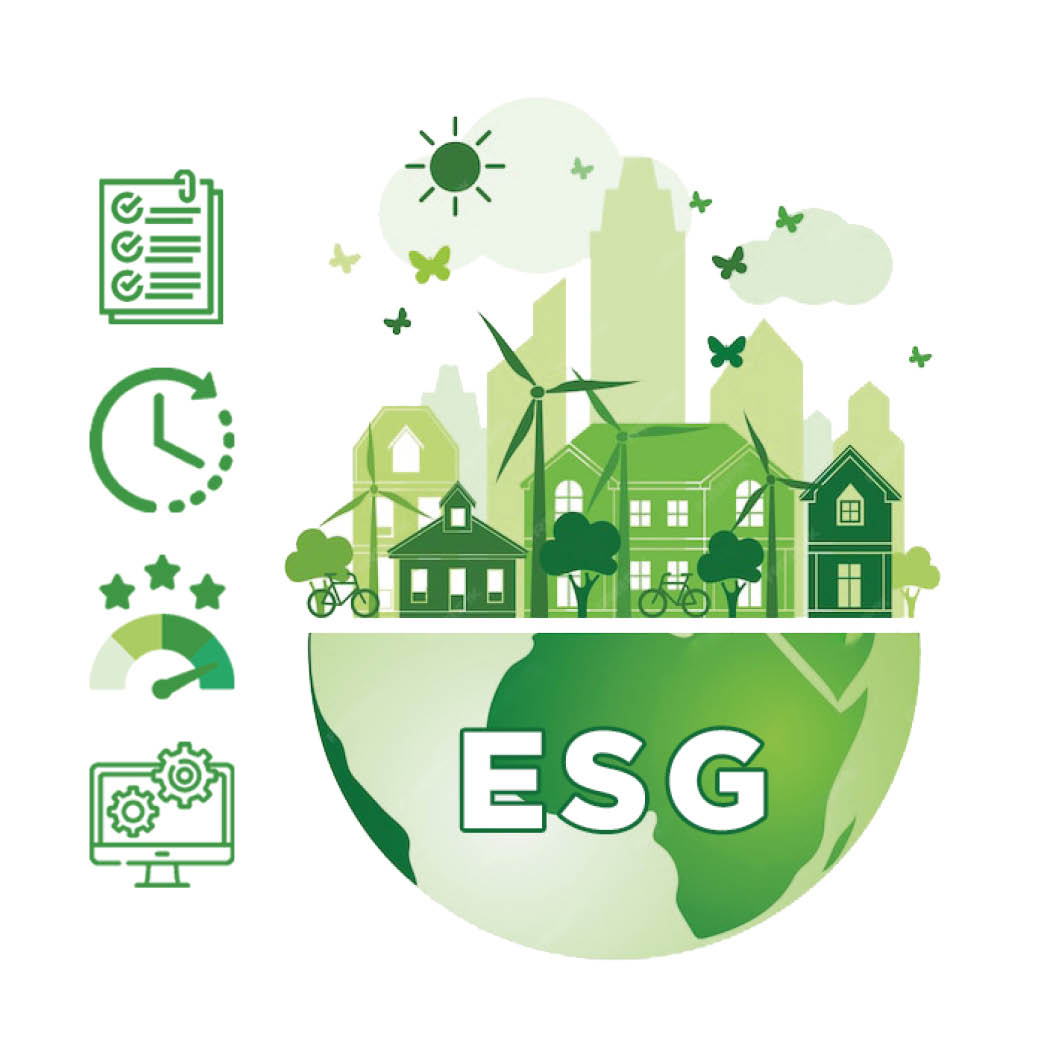
ESG is based on 3 fundamental pillars: environmental, social and governance. These pillars are essential for analyzing investment risk and for assessing an organization's social and environmental impact. The EU CSRD (Corporate Sustainability Reporting Directive) extends these assessments to a larger number of companies, strengthening corporate transparency and accountability.
ESG: regulations and rating
ESG regulations represent a set of criteria used to assess a company's performance in environmental, social and governance terms. These principles are used to analyze the investment risk in a given organization.
The ESG rating is usually determined by analyzing data and metrics relating to the organization's intangible resources, such as its environmental footprint, its social impact and the effectiveness of its corporate governance. This assessment acts as a kind of social reputation index, since it aims to rank a company's commitment to sustainability and to evaluate its positive or negative impact on society and the environment.
ARXivar NEXT ESG
Want to learn more about ESG topics?
ARXivar NEXT ESG
Take stock of your company's ESG situation and plan your activities toward sustainability.
Discover more
The new EU Directive 2022/2464 (Corporate Sustainability Reporting Directive – CSRD)
The directive concerns the obligation to report non-financial information (environmental, social and governance information) for all large companies and for small and medium-sized enterprises that qualify as public-interest entities, with the exception of micro-enterprises. A company is defined as “large” if, at the balance sheet date, it exceeds two of the following three thresholds:
Total assets: exceeding €20 million;
Revenue: exceeding €40 million;
Average annual employees exceeding 250.
Benefits of adopting ESG policies
Companies must therefore adopt an ESG strategy in order to meet the expectations of investors, shareholders and all stakeholders
Talent attraction and retention: employees, especially younger generations, tend to prefer companies that demonstrate a commitment to sustainability and social responsibility.
Access to capital: investors are increasingly oriented toward companies that demonstrate a commitment to sustainability.
Risk mitigation: integrating environmental, social and governance considerations into decision-making helps identify and mitigate potential risks before they become problematic. For example, strong governance can reduce the risk of legal or ethical scandals, while a solid environmental policy can prevent reputational damage caused by unsustainable practices.
Innovation and competitiveness: companies are driven to develop new products or services that are both sustainable and technologically advanced. This can lead to a valuable market differentiation, consolidating the company's position as a leader in its sector.
Compliance and stakeholder relations: being in line with ESG regulations helps avoid penalties and improves relations with regulators and other stakeholders, including customers, partners and local communities.
How to achieve ESG goals
It is not enough for a company to be willing to become more responsible; it also needs a tool to measure and track the progress made toward achieving these goals. ARXivar's ESG module, designed for creating sustainability reports, gives companies and SMEs access to the ARXivar platform, which, thanks to its workflows, can create automated processes to assess their level of sustainability, identify strengths and areas for improvement, and start a sustainable transition journey to become increasingly competitive on the market.
Oversee activities: manage stakeholder relationships and plan engagement initiatives in just a few steps
Collect and verify data: coordinate data collection and monitor its validation in real time
Generate reports and statements: generate reports on environmental, social and governance (ESG) factors and draft the Sustainability Report
The Adawen Solution: Customization and Verticalization
Adawen, as a Silver partner of ARXivar, is able to offer a unique solution, verticalizing and customizing the document and process management software linked to the ESG module. Through an in-depth analysis of your specific needs, we propose ad hoc configurations that optimize workflows, improve ESG document management and facilitate compliance. Our know-how allows us to implement solutions that not only meet immediate needs, but are also scalable and adaptable to future business and regulatory developments.
Through a guided process, we help you understand your company's current sustainability situation, define your goals and measure results.
Self-assessment: helps you understand your company's current sustainability situation, identifying the most important issues to address.
Material topics: to achieve your sustainability goals, we recommend identifying the most relevant material topics and focusing on them.
Content and indicators: to effectively track your company's progress toward its sustainability goals, we recommend using indicators, data, charts and visual content.
Activities: to keep your ESG plan always up to date, we recommend assigning actions and deadlines within your report.
Request more information